
How to Run a Multi-Chapter Referral Network (Without Losing Track of Any Chapter)
What changes when one referral group becomes five: shared standards, five numbers to watch, cross-chapter referrals and spotting a chapter that needs help.
Published November 22, 2026
Running several referral chapters is a different job from running one. You stop being the person who greets guests and start being the person who notices, three months early, that one chapter's attendance is slipping. The networks that grow keep a few things the same everywhere, look at every chapter side by side once a month, and step in before a small chapter becomes a closed one.
What actually changes at chapter two
With one chapter, problems are visible. You're in the room, you see who's missing, you hear when referrals dry up. With two or more, you're relying on chapter leaders to tell you, and most volunteers won't say "we're struggling" until it's obvious.
So the work shifts from doing to seeing. You need the same numbers from every chapter, in the same format, at the same time each month. Without that, every leader reports differently, and you end up comparing a chapter that counts guests with one that doesn't.
Decide what stays the same in every chapter
Pick a short list of things that are non-negotiable across the network, and let chapters choose everything else.
- One professional per category. If one chapter allows two realtors and another doesn't, members notice.
- What counts as a referral. Agree on the definition of a qualified referral so the totals mean the same thing everywhere.
- How closed business is reported. Who enters the amount, and when.
- Meeting basics. Weekly or every other week, roughly how long, and what happens in the first ten minutes.
- Brand and website. Same look, each chapter's own members and meeting details.
Leave the meeting place, time, speaker schedule and social events to each chapter. Leaders who feel trusted stay longer.
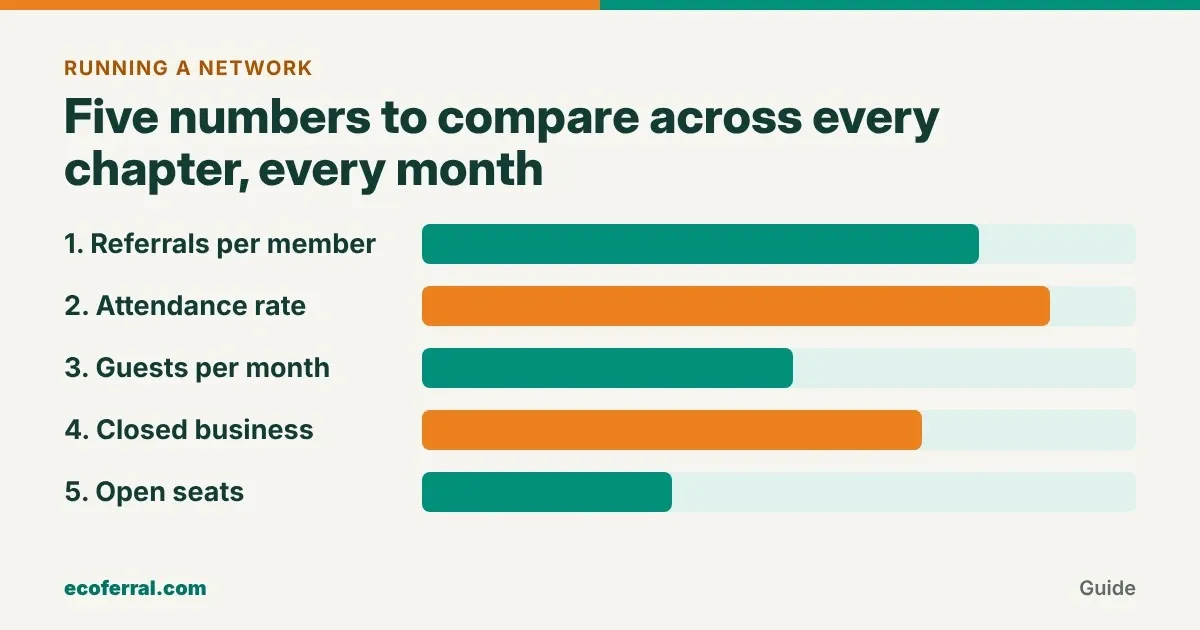
The five numbers to watch every month
You don't need a dashboard with thirty charts. Five numbers, compared across chapters, tell you almost everything:
- Referrals passed per member. The heartbeat of a chapter. A drop here usually comes before a drop in membership.
- Attendance rate. Members who show up refer more and renew more.
- Guests per month. No guests today means fewer members next quarter.
- Closed business. The number that keeps members paying dues.
- Open seats. How many key categories are still empty.
Look at the trend, not the single month. A chapter that dips in December is normal. A chapter that dips three months running needs a call.
How to spot a chapter that needs help
The warning signs show up in a predictable order: guests stop coming, then referrals per member fall, then attendance slides, then renewals. By the time renewals drop, you're rebuilding.
When a chapter shows two of those signs together, talk to the chapter leader that week. Ask what's going on before you suggest anything. Often it's simple: the leader is burned out, the meeting room changed, or one strong member left and took the energy with them. A visitor day, a new co-leader or a borrowed speaker from another chapter fixes more than any policy does.
Make cross-chapter referrals easy
One of the best reasons to belong to a network instead of a single group is reach. A member in one chapter should be able to send business to a member in another without digging for a phone number.
Count those referrals the same way you count in-chapter ones, credit the person who gave them, and mention them at meetings. When members see a referral arrive from across town, they start thinking of the whole network as theirs.
Who does what: the network and the chapters
Most friction in a growing network comes from blurry roles. Write down who owns what, even if it's a single page.
The network handles starting new chapters and finding their first leaders, the shared standards above, training new chapter leaders, monthly numbers across all chapters, and network-wide sponsors and events.
Each chapter leader handles running the weekly meeting, approving new members and guarding category seats, following up with guests, their chapter's speakers and visitor days, and telling the network early when something isn't working.
When a chapter leader asks "can we change this?", the answer should be quick: if it's on the network list, no; if it isn't, it's their call.
Starting a new chapter inside the network
New chapters struggle for the same reason new restaurants do: too few people in the first months. Give them a head start.
- Seed it with a core group. Six to eight committed founding members, often people who were waiting for a taken category in another chapter.
- Lend experienced members. Ask a few members from an established chapter to visit for the first month. They show new members what a good meeting feels like.
- Hold a launch visitor day. Invite every member across the network to bring one guest.
- Watch it more closely. Check the new chapter's numbers every two weeks for its first quarter.
Report back to the chapters
Leaders work harder when they can see their own numbers next to the network's. A short monthly report, sent to every chapter leader, does more than a quarterly meeting. Keep it factual and kind. "Your guest numbers are the highest in the network" lands better than a ranking table.
Tools that help
Spreadsheets break down around the second or third chapter, because every leader keeps theirs slightly differently. Purpose-built software keeps every chapter on the same footing.
In Ecoferral, each chapter runs its own week (referrals, check-in, guests and its own website) and the network sees every chapter side by side, with a monthly report that flags chapters that may need support. Cross-chapter referrals show in both chapters' lists. Network plans cost $30 a chapter a month with a $99 monthly minimum, and members never pay.
A simple monthly routine
- First week: read the network report. Note any chapter with two warning signs.
- Second week: call those chapter leaders. Listen first.
- Third week: share one win from each chapter with the whole network.
- Fourth week: plan next month's visitor days and speaker swaps.
An hour a week is enough for a network of five to ten chapters, as long as the numbers come to you instead of you chasing them.
Questions
How many chapters can one person oversee?
With consistent monthly numbers, one person can usually keep an eye on five to ten chapters in about an hour a week. Past that, add a regional lead.
What is the best metric for a referral chapter's health?
Referrals passed per member per month. It usually falls before attendance and renewals do, so it gives you the earliest warning.
What is a cross-chapter referral?
A referral from a member of one chapter to a member of another chapter in the same network. Counting and celebrating them is what makes a network feel bigger than one group.
How do you start a new chapter in an existing network?
Start with six to eight founding members, borrow a few experienced members from another chapter for the first month, hold a launch visitor day, and check the new chapter's numbers every two weeks for its first quarter.
Should every chapter meet on the same day?
No. Keep the standards the same (one per category, how referrals count) and let each chapter pick its own day, time and place.
How much does multi-chapter referral software cost?
It varies. Ecoferral's network plans are $30 a chapter a month with a $99 minimum. Some tools price per organization instead, so compare the cost at your actual number of chapters.
More in Running a networking group
- How a Chamber of Commerce Can Run Member Referral Groups
- Running a Weekly Referral Group on Ecoferral: Before, During and After Every Meeting
- Referral Networking Software: What to Look For (A Comparison Checklist)
- A Website for Your Networking Chapter (on Your Own Domain)
- Ecoferral vs. Spreadsheets and Google Forms for Tracking Referrals
- How Much Should a Networking Group Charge? Dues, Application Fees and Meals
- How to Collect Dues for Your Networking Group Online
- How to Run a Visitor Day for Your Networking Group