
How to Keep Referral Group Members Engaged (and Renewing)
Members rarely quit a referral group over price; they quit when the business stops. How to spot quiet members early and keep everyone renewing.
Published November 22, 2026
Members almost never leave a referral group because of the dues. They leave because, somewhere around month eight, they stopped getting referrals and nobody noticed. Keeping members engaged comes down to three habits: make sure every member gets a 1-to-1 and a referral early, notice when someone goes quiet, and show members the business the group has produced for them.
Why members drift
Look at the members who didn't renew last year. Most of them followed the same pattern. They joined excited, attended well for a couple of months, received a referral or two, then the referrals slowed. They started missing meetings. By renewal time, the decision had already been made.
The good news is that this pattern is visible months before renewal, if you're looking.
The first 90 days decide it
A new member who gets a real referral in their first three months is far more likely to stay. Make that happen on purpose.
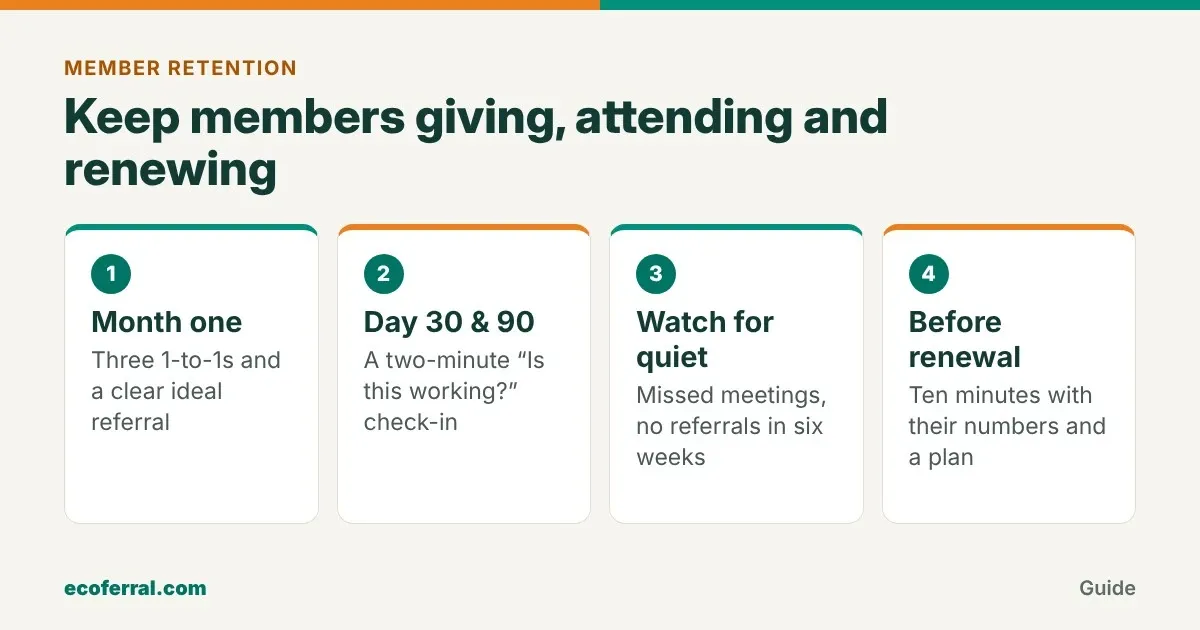
- Pair them up. Give every new member three 1-to-1s with established members in their first month, starting with the people most likely to refer them.
- Get their ideal referral on record. Members can't refer someone whose business they don't understand. A clear one-line ideal referral helps more than a long introduction.
- Ask a member to look out for them. One person whose job is to send the new member something in the first quarter.
- Check in at day 30 and day 90. A two-minute conversation: "Is this working for you?"
Spot the quiet ones
Three signals tell you a member is drifting:
- They've missed two of the last four meetings.
- They haven't given a referral in six weeks.
- They haven't received one in two months.
Any one of these deserves a friendly call. Two together means renewal is at risk. The call isn't a scolding. It's "We missed you. What would make the group more useful to you right now?"
Make giving easy
Members give more referrals when it takes seconds. If giving a referral means finding a paper slip, remembering a phone number and writing a summary, people put it off and forget.
Suggestions help too. Prompting a member with who they haven't referred in a while, or who sent them business recently, turns "I can't think of anyone" into a referral.
Show members what they've gained
Members renew when they can see the value in numbers. Once a quarter, show each member:
- Referrals they've received, and how many closed
- Closed business they've earned through the group
- 1-to-1s they've had
- Their attendance
A member who sees "you've received $14,000 in closed business this year" doesn't argue about dues. A member who has no idea what they've gained does.
Keep meetings worth the drive
Engagement also lives in the room. Start on time, end on time, and protect the parts members value: referrals passed, a member presentation and real thank-yous for closed business. Rotate presenters so every member gets a turn to teach the room about their business. A Member Spotlight now and then gives members another way to be seen.
Celebrate closed business out loud
The single best moment in a referral meeting is when a member stands up and thanks another for business that closed. It shows new members the group works and reminds everyone why they're there. Make room for it every week.
How software helps
Tracking attendance, referrals given and received, and 1-to-1s by hand is exactly the work that slips when a volunteer leader gets busy. In Ecoferral, members give a referral in seconds, the app suggests who they could refer next, and each member gets a monthly report of their referrals, closed business and points. Leaders can see who's gone quiet before renewal time.
Have the renewal conversation early
Don't let renewal arrive as an invoice. About six weeks before a member's renewal date, the leader (or a membership chair) sits down with them for ten minutes.
Bring their numbers: referrals given and received, closed business, attendance. Then ask three questions:
- What's been most useful about the group this year?
- Who in the room do you wish you knew better?
- What kind of referral would make next year a great one?
The second question usually leads to a 1-to-1 that week. The third gives the whole chapter something specific to look for. Members who have this conversation tend to renew, because they leave it with a plan instead of a bill.
When a member does leave
Some will, and that's fine. People retire, change jobs or move their business. Ask them one honest question on the way out: "What would have made you stay?" Write the answers down. After a year you'll have a short list of fixable reasons, and it's usually more useful than any survey.
Leave the door open, too. A member who leaves on good terms often sends referrals anyway, and sometimes comes back.
If your chapter is still growing, see how to grow a networking chapter for bringing in guests. This guide is about keeping the members you already have.
Questions
Why do members leave referral groups?
Usually because they stopped receiving referrals and nobody noticed. Price is rarely the real reason.
How can I tell a member is about to leave?
Watch for missed meetings, no referrals given in six weeks and none received in two months. Two of those together means renewal is at risk.
What should a new member do in their first month?
Hold three 1-to-1s with established members, write a clear ideal referral, and attend every meeting. A referral in the first 90 days makes staying far more likely.
How often should members see their results?
At least quarterly, and monthly is better: referrals received, closed business, 1-to-1s and attendance.
More in Running a networking group
- How a Chamber of Commerce Can Run Member Referral Groups
- Running a Weekly Referral Group on Ecoferral: Before, During and After Every Meeting
- Referral Networking Software: What to Look For (A Comparison Checklist)
- A Website for Your Networking Chapter (on Your Own Domain)
- Ecoferral vs. Spreadsheets and Google Forms for Tracking Referrals
- How Much Should a Networking Group Charge? Dues, Application Fees and Meals
- How to Collect Dues for Your Networking Group Online
- How to Run a Visitor Day for Your Networking Group