
How to Find Sponsors for a Networking Group (and What to Offer Them)
Who to ask, what sponsors want, how to price a chapter sponsorship, and how to avoid upsetting members in the same line of business.
Published November 22, 2026
Most networking groups can cover a good share of their costs with one or two local sponsors, but few ask. The ones that succeed treat sponsorship as a small, honest advertising deal: a local business gets seen every week by a room of business owners, and the group gets money for meals, a better room or a visitor day. The trick is offering something visible, pricing it simply and never putting a sponsor in front of a member who competes with them.
Why a business would sponsor your group
Think about it from the sponsor's side. Your group is a room of 15 to 40 local business owners who meet every week and trust each other. That's an audience most small businesses can't buy anywhere else.
The best sponsors want one of three things:
- To be known by business owners. Banks, credit unions, payroll companies, commercial insurance.
- To support the community. Local employers who like being seen backing small business.
- To reach a specific audience your members serve. A print shop, a sign company, a coworking space.
Who to ask first
Start with people who already know you.
- Former members whose business has grown.
- Members' own vendors (their bank, their accountant, their print shop). An introduction from a member beats a cold call every time.
- Venues. The restaurant or event space you meet in sometimes sponsors in exchange for the visibility.
- Local employers who hire from your members' networks.
A short, specific ask works better than a sponsorship deck. "We'd like you to be our chapter sponsor for the next six months. Here's what that includes, and here's what it costs."
What to offer
Sponsors renew when they see their name in front of the right people, regularly. Offer things that happen every week, not a logo on a page nobody visits.
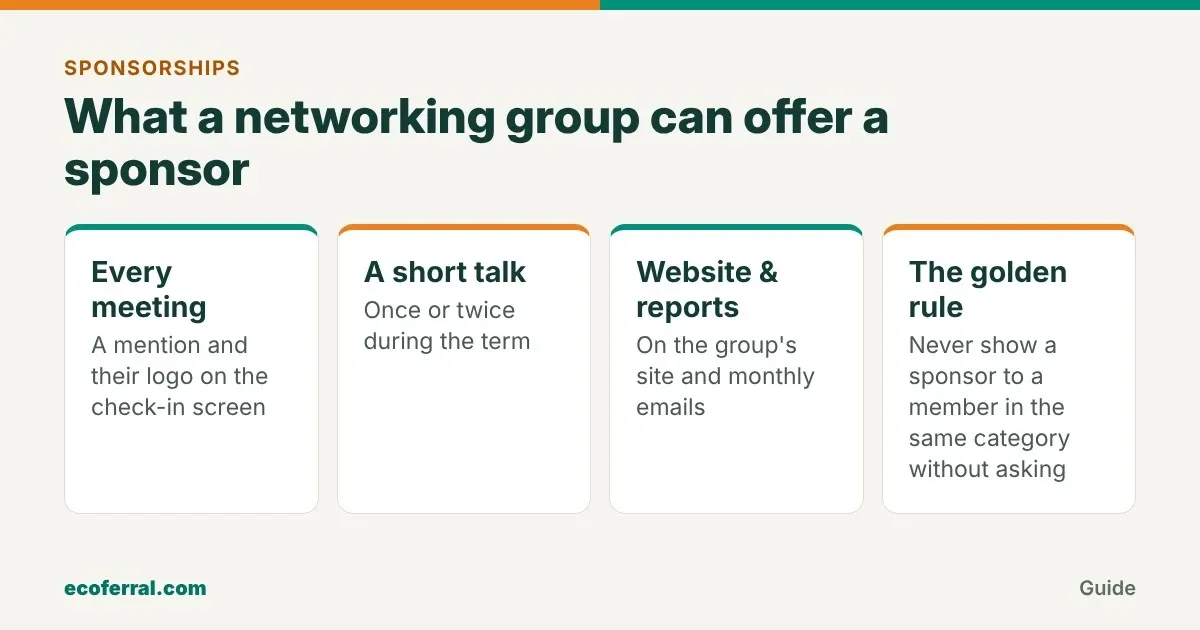
- The meeting itself: a mention at the start of each meeting and their logo on the check-in screen.
- A short talk once or twice during the term.
- The group's website and member directory.
- Monthly reports or emails that go to every member.
- A table at the visitor day.
Pick three or four. More than that gets hard to deliver, and a sponsor who was promised six things and noticed two won't renew.
How to price it
Keep it simple and time-bound. A three-, six- or twelve-month term with one price is easier to sell than a menu.
To set the number, start with what you need (meals for guests, a better room, a visitor day) and divide across the year. Then sanity-check it against what the sponsor would pay for a local print ad or a community event table. Most small groups land somewhere between a few hundred and a couple of thousand dollars a year per sponsor, depending on group size and what's included.
Write it down in a one-page agreement: what they get, for how long, what it costs, and when it renews.
The rule that protects your members
Never show a sponsor in a chapter where a member holds the same category, unless that member says it's fine. If your chapter's insurance agent walks in to see a rival agency's logo on the screen, you've lost a member to gain a sponsor.
Check the sponsor's category against your roster before you sign. If there's a conflict, ask the member first. Many will agree, especially if the sponsor serves a different market, but they should be asked, not told.
Member Spotlight: a smaller option
Not every business wants a full sponsorship. A monthly Member Spotlight lets one member feature their own business on the check-in screen and members' home screens for a month, for a modest fee paid to the chapter. It's a nice way for members to support the group and promote themselves at the same time.
Report back
At the end of each month, tell your sponsor what they got: how many meetings, how many members and guests saw their name, and anything that came of it. Sponsors who can see their reach renew. Sponsors who hear nothing assume nothing happened.
In Ecoferral, chapter sponsors appear on the check-in screen, in reports and on members' home screens, and a network sponsor can be shown across chapters while being kept out of any chapter where a member holds its category.
A quick checklist
- List five local businesses that would value your members' attention
- Ask members for warm introductions
- Offer three or four visible things, for a fixed term and price
- Check for category conflicts before signing
- Send a short monthly reach report
- Ask about renewal a month before the term ends
Questions
How much should a networking group charge for sponsorship?
Start from what the group needs for the year and divide it across one or two sponsors. Many small groups charge a few hundred to a couple of thousand dollars a year, depending on size and what's included.
What do sponsors get from a networking group?
Regular visibility with local business owners: a mention at each meeting, their logo on the check-in screen and website, a short talk during the term, and their name in member reports or emails.
Can a sponsor be in the same industry as a member?
Only if that member agrees. Showing a competitor's logo to a member in the same category is the fastest way to lose that member.
What is a Member Spotlight?
A smaller paid feature where one member's business is shown on the check-in screen and members' home screens for a month, with the fee going to the chapter.
More in Running a networking group
- How a Chamber of Commerce Can Run Member Referral Groups
- Running a Weekly Referral Group on Ecoferral: Before, During and After Every Meeting
- Referral Networking Software: What to Look For (A Comparison Checklist)
- A Website for Your Networking Chapter (on Your Own Domain)
- Ecoferral vs. Spreadsheets and Google Forms for Tracking Referrals
- How Much Should a Networking Group Charge? Dues, Application Fees and Meals
- How to Collect Dues for Your Networking Group Online
- How to Run a Visitor Day for Your Networking Group