
Is My Referral Group Worth It? How to Measure the ROI of a Networking Group
How to tell if your referral or networking group membership pays off: what to count, a worked example, and what to do if the numbers are low.
Published November 22, 2026
To find out whether a referral group is worth it, add up the closed business you received from members over the last 12 months, estimate your profit on it, and compare that with what membership really costs you, including your time. If the profit is several times the cost, it's working. If it isn't, the numbers usually show why, and it's often fixable.
Why most members can't answer the question
Ask a referral group member whether their membership pays off, and most will say "I think so." Very few can give a number. That's not because the value isn't there. It's because nobody tracked it.
Leads get passed on paper slips, the business closes weeks later, and nobody connects the two. By renewal time, you're deciding on a feeling. A few simple numbers change that.
What to count
What you received:
- Closed business from referrals. The total value of jobs or sales that came directly from leads members passed you.
- Second-generation business. Work that came from a referred client's own referrals. It's real, but count it separately so you're not overstating.
- Repeat business from clients the group sent you, over the year.
What it cost:
- Dues and fees, including any application fee.
- Meals, if your group meets over breakfast or lunch.
- Your time. Weekly meetings, travel and 1-to-1s. Put an honest hourly value on it.
What you gave:
- Referrals you passed. Not part of your own return, but members who give more tend to receive more, so it's worth knowing.
A worked example
Here's a simple year for a fictional bookkeeper.
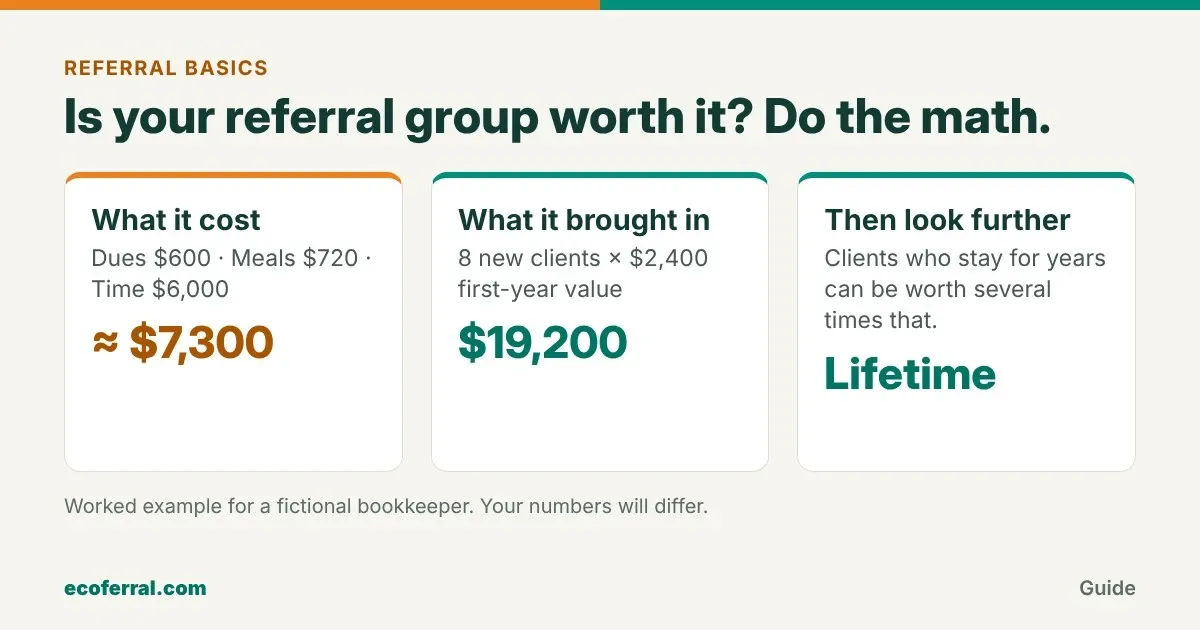
Cost: dues of $600, meals of about $15 a week for 48 meetings ($720), and about 2.5 hours a week including travel and 1-to-1s. At $50 an hour, that's 120 hours, or $6,000. Total: about $7,300.
Return: members referred eight new clients who closed. Average first-year value per client: $2,400. That's $19,200 in closed business. At a 40% profit margin, that's $7,680 in profit, plus whatever those clients are worth in later years.
On first-year profit alone, the group is roughly breaking even once time is counted. But bookkeeping clients often stay for years. Over three years, those eight clients could be worth well over $50,000 in revenue, and the picture changes completely.
That's why it's worth looking at lifetime value, not just this year's invoices, for any business where clients come back.
The simple version
If the full calculation feels like too much, use this rule of thumb: divide the closed business you received in the last year by your total dues and meals. A common rule of thumb is closed business worth at least five to ten times your direct costs, before counting time. Adjust that target for your own profit margin.
What the numbers tell you
Lots of referrals, little closed business. The leads may not be a good fit. Get more specific about your ideal referral, and teach members what a good lead looks like for you.
Few referrals at all. Members may not understand what you do. Hold more 1-to-1s, use your presentation to tell one specific client story, and ask for something narrow ("a homeowner planning a kitchen remodel in the next six months") rather than "anyone who needs a contractor."
Strong results, but the time cost is high. Look at where the hours go. Shorter, more focused 1-to-1s often help.
You give far more than you receive. That's worth a conversation with your group leader. It may be a category mismatch, or the group may need more members who serve your kind of client.
Track it as you go
The easiest way to answer "is it worth it?" is to never have to reconstruct the year. Record each referral when you receive it, update it when it closes, and enter the amount. Twelve months later, the answer is already there.
Many groups track this in a shared spreadsheet. Purpose-built software makes it automatic: in Ecoferral, the person who receives a referral marks it closed and enters the amount, and every member gets a monthly report of referrals received, closed business and attendance. See how to track closed business (TYFCB explained) for the group's side of it.
Before you decide to leave
If the numbers are disappointing, give it one focused quarter before quitting. Hold a 1-to-1 with every member, rewrite your ideal referral, and ask your leader for help. Most members who turn their results around do it by being more specific, not by switching groups.
Questions
How do I calculate the ROI of a networking group?
Add up the closed business you received from members in the last 12 months, estimate your profit on it, and compare that with your dues, meals and the value of your time. Include repeat business from referred clients where it applies.
What is a good return on a referral group membership?
A common rule of thumb is closed business worth five to ten times your direct costs (dues and meals), adjusted for your profit margin. Businesses with repeat clients should also look at lifetime value.
Should I count my time as a cost?
Yes. Weekly meetings, travel and 1-to-1s add up to the biggest cost for most members. Put an honest hourly value on it.
What if I give more referrals than I receive?
Talk to your group leader. Often members don't yet understand your ideal referral, or the group needs more members who serve the same kind of clients you do.
How long should I give a referral group before deciding?
Many members find it takes six to twelve months to build the relationships that produce steady referrals. If results are low after that, try one focused quarter of 1-to-1s and a sharper ideal referral before leaving.
More in Referral basics
- Referral Networking for Marketing Agencies and Web Designers
- Referral Networking for Real Estate Agents
- 1st vs. 2nd Generation Referrals: What's the Difference?
- 1-to-1 Meeting Questions for Referral Partners (with a Template)
- 60-Second Commercial Examples for Networking Meetings
- How Referral Networking Grows a Small Business
- Referral Networking for Accountants, CPAs and Bookkeepers
- Referral Networking for Contractors and Home Service Businesses